Is a Tulip Poplar Safe to Keep Near Your House?

A tulip poplar can stay near a house when the yard has room for a very large tree and the limbs over the roof are sound. The USDA Forest Service's Silvics of North America reports that mature trees "more often" reach 100 to 150 feet with straight trunks 2 to 5 feet across, and the USDA NRCS plant guide for the species warns that "the tree is susceptible to storm damage." When a big one hangs over the house or keeps dropping limbs, trimming or tree removal is the practical fix.
Silvics, published in 1990, also shows how fast the species climbs: it records an 11-year-old natural seedling 50 feet tall, and in western North Carolina the dominant sprout on each of 60 stumps on a good site grew an average of 4.7 feet a year over its first 6 years. The same manual warns that "Sleet and glaze storms, which occur periodically within the range of yellow-poplar, may cause considerable damage," and that "tops of dominant and codominant trees are often broken." This post covers the tree's size, growth rate, storm and ice breakage, roots, problems you can see from the ground, tulip poplars in Pennsylvania, and when removal or trimming makes sense.
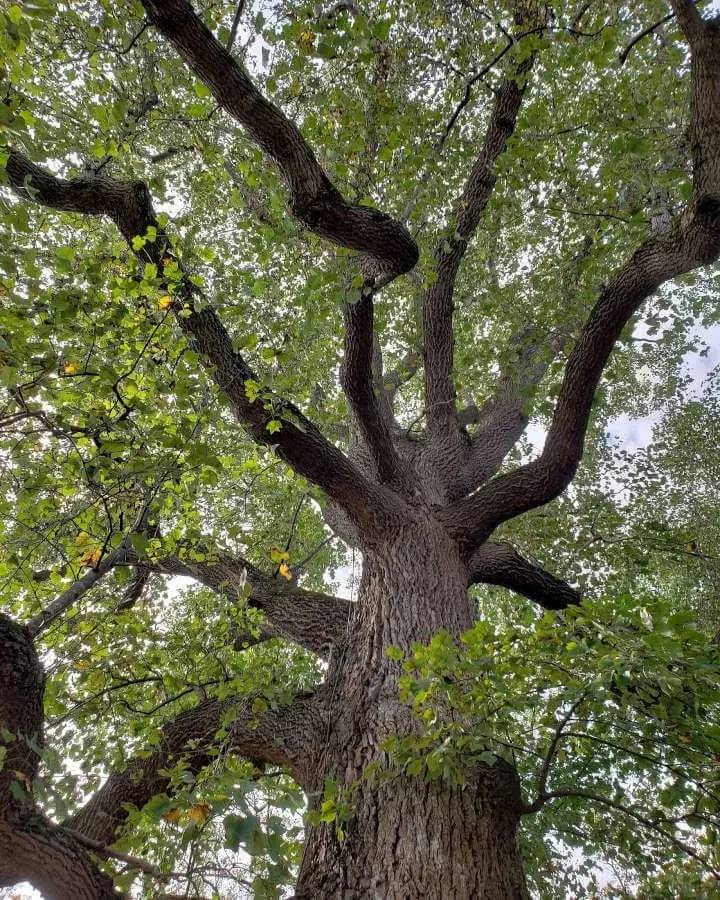
How Tall Does a Tulip Poplar Get?
The tulip poplar (Liriodendron tulipifera), also called tuliptree or yellow-poplar, is a large, fast-growing, long-lived tree native to eastern North America, as the NRCS plant guide describes it. Silvics calls it "among the tallest of all Eastern United States broadleaf trees" and says old-growth trees on the best sites may be nearly 200 feet tall and 8 to 12 feet in diameter.
Yard-scale figures depend on the source:
NRCS: 70 to 120 feet tall, with a crown 40 to 50 feet wide
UF/IFAS Extension: 80 to 100 feet tall and 30 to 50 feet wide
The Morton Arboretum in Illinois: 70 to 90 feet tall and 35 to 50 feet wide
The record trees go higher. NRCS notes that the 2021 national champion, in Virginia, measured 139 feet, and that "Some previous records indicate trees taller than 190 feet." UF/IFAS says the largest trees in the East grow in North Carolina's Joyce Kilmer Forest, some reaching more than 150 feet with seven-foot diameter trunks.
Now set those numbers beside a house. A tree at the low end of Silvics' mature range, 100 feet, with its trunk 60 feet from your back wall, is tall enough to reach past the roof if it ever came down that way. A crown 40 to 50 feet wide, per NRCS, puts branch tips 20 to 25 feet out from the trunk.
How Fast Does a Tulip Poplar Grow?
Fast while young, then slower. According to Silvics, trees may be 10 to 18 feet tall at the end of 5 years. The Morton Arboretum lists the growth rate as fast, and NRCS calls the tree fast-growing.
UF/IFAS lists the growth rate as moderate and explains that the tree has a "moderate to rapid (on good sites) growth rate at first but slows down with age."
The tree also stays a long time. Silvics notes that "Age at natural death is usually about 200 to 250 years," and that some trees may live up to 300 years. A seedling beside a foundation or deck is worth pulling while it is small.
Is Tulip Poplar Wood Weak in Ice and Storms?
The sources split on this. The Morton Arboretum lists "Highly susceptible to ice damage" and "Weak wood and branch structure" among its planting considerations. NRCS says the tree "is susceptible to storm damage and the self-pruning habit can lead to small branch and twig loss."
UF/IFAS Extension, writing from Florida, rates breakage as "resistant." Its fact sheet says "The soft wood reportedly is subject to storm damage but the trees held up remarkably well in the south during hurricane 'Hugo'," and adds, "It is probably stronger than given credit for."
Hurricane wind and a coat of ice are different tests, and for ice, Silvics and Morton speak directly. In Silvics' description, slender trees may be broken off in those storms. It adds that although yellow-poplar "usually makes remarkable recovery after such storms, repeated damage can result in a growth reduction and loss of quality."
Two more Silvics points matter for a yard tree. Grapevines worsen winter storm damage in some areas by giving ice and snow more surface to build up on, and "Top damage is often the point of entry for fungi." For why big limbs can fail with little notice, see why large limbs break without warning.
What Do Tulip Poplar Roots Do Near a House?
They go deep and spread wide. NRCS says "Tulip poplar has a deeply penetrating taproot with spreading lateral roots and should be given ample space." Silvics describes the same pattern: a rapidly growing, deeply penetrating juvenile taproot "as well as many strongly developed and wide-spreading lateral roots."
UF/IFAS rates the roots "not a problem" in its fact sheet, and The Morton Arboretum describes a fleshy root system. None of the sources behind this post ties tulip poplar roots to foundation, pipe or sewer damage.
NRCS refers to "the required space away from structures to prevent damage" but gives no distance in feet. UF/IFAS says tulip-poplar "could be used along residential streets with very large lots and plenty of soil for root growth if set back 10 or 15 feet," which is a street setback, not a house distance.
For a broader way to judge spacing, read Brinko's guide on when a tree counts as too close to a house in PA.
What Tulip Poplar Problems Can You See From the Ground?
Signs the sources describe:
Sticky residue on lower limbs, other plants, cars, buildings and pavement from tuliptree aphids and scale, which NRCS says "can cause permanent damage or staining"
Yellow interior leaves dropping in summer, which UF/IFAS links to hot, dry weather and NRCS lists with leaf scorch as drought stress symptoms
Small branches and twigs on the lawn from the tree's self-pruning habit, per NRCS
Broken tops after sleet or glaze storms, per Silvics
UF/IFAS also names tuliptree aphid, tuliptree scales, sooty mold, leaf spots, cankers and verticillium wilt among the pests and diseases of the species. Sorting out which one you have is a question for the Penn State Extension Westmoreland County office.
NRCS adds a caution on cutting: "Pruning is not recommended unless branches are dead, dying, or hazardous as wounds can leave the tree susceptible to wood rots." When limbs over the house fit that description, Brinko Tree Service's pruning and trimming handles dead branch removal, plus hazardous limb removal for weak or overhanging branches above the roof, a parked car or a power line.
Tulip Poplars in Pennsylvania Woodlots and Westmoreland County Yards
Pennsylvania sits at the north end of the tree's stronghold. Silvics says "The Appalachian Mountains and adjacent Piedmont running south from Pennsylvania to Georgia contained 75 percent of all yellow-poplar growing stock in 1974." In the USDA Forest Service's 2012 inventory of Pennsylvania's forests, yellow-poplar ranked seventh among the state's species by live-tree volume, at 1,772.7 million cubic feet, up 16.0 percent since 2007.
One of the growth studies Silvics cites was done in Pennsylvania: seedlings had a 95-day height-growth period beginning late April and ending about August 1.
Winter brings the risk. The sleet and glaze storms Silvics describes occur periodically within the tree's range, which takes in Pennsylvania. For a homeowner in North Huntingdon, Harrison City, Greensburg, Irwin or Murrysville, the time to look up is after an ice storm, checking for a snapped top or hanging limbs over the roof.
Lightning raises its own questions for a tall yard tree. If one has been hit, Brinko's guide explains whether a tree struck by lightning will die.
To confirm a tree is a tulip poplar, or to ask about something on its leaves or bark, contact the Penn State Extension Westmoreland County office at 214 Donohoe Road, Suite E, in Greensburg, 724-837-1402.
When Is Removing a Tulip Poplar the Practical Answer?
Silvics calls yellow-poplar "an excellent ornamental for park and garden where there is adequate space to accommodate its large size." Virginia Cooperative Extension calls it "too large for the average-sized home landscape."
Removal is easier to justify when a large tulip poplar stands close enough to reach the house, when its top has broken in an ice storm, when limbs keep dropping over a driveway or roof, or when sticky residue stains a car or patio each summer. Trimming may be enough when the tree has room and only a few dead or hazardous limbs hang over the house.
Brinko Tree Service takes on trees that are hazardous, dead, diseased or unwanted, rigging big ones carefully when they stand near a house, fence or utility line and clearing the debris afterward. We can also set up wood chipping or log splitting, and stump grinding is offered as its own service.
For what a job this size involves, see large tree removal and why big trees cost more.
FAQ
What is the downside of a tulip poplar tree?
Size is the first. A tree that NRCS says can grow 70 to 120 feet tall with a crown 40 to 50 feet wide needs a big lot. Beyond that, NRCS points to twig drop from self-pruning and sticky aphid residue on cars and buildings, and The Morton Arboretum flags weak wood and ice damage.
Is there a difference between a tulip tree and a tulip poplar?
No. They are two common names for the same tree, which Silvics also lists as yellow-poplar and tuliptree. The "poplar" part is misleading. NRCS says "Despite its common name, tulip poplar is not a poplar and instead, belongs to the Magnolia family (Magnoliaceae)." Purdue's forestry department likewise calls it "more closely related to the magnolia family than the poplar family."
Are tulip tree roots invasive?
No source here uses that word for them. UF/IFAS rates the roots "not a problem," while NRCS and Silvics describe a deep taproot with wide-spreading lateral roots that needs room to grow. The sources' concerns about a tulip poplar near a house center on its height and limbs, not its roots.
How big will a tulip tree get?
Plan for 70 to 120 feet tall with a crown 30 to 50 feet wide, the span of the NRCS, UF/IFAS and Morton Arboretum figures. Forest trees can grow taller, and in Silvics' account old-growth trees may reach nearly 200 feet on the best sites.
How far away from your house should you plant a tulip poplar tree?
No source behind this post gives a distance in feet. NRCS says the tree needs space away from structures to prevent damage, and its 40 to 50 foot crown means branches reaching 20 to 25 feet from the trunk, so a trunk closer than that puts mature limbs over the roof. UF/IFAS's only setback, 10 or 15 feet, is for street plantings on very large lots. For a site-specific answer, ask the Penn State Extension Westmoreland County office.
Is tulip poplar good for anything?
Yes. NRCS says the wood "is used for construction grade lumber, plywood, and pulpwood," and Purdue's forestry department, citing the Wood Database, lists pallets, crates, upholstered furniture frames, paper and plywood. Silvics says "It has distinctive value as a honey tree." As firewood, NRCS says the wood dries quickly and splits easily but "is only considered fair quality firewood because it burns quickly." UF/IFAS suggests the tree is "probably best for a specimen or for lining commercial entrances with lots of soil space."
Tulip Poplar Trimming and Removal From Brinko Tree Service
Brinko Tree Service trims dead and hazardous limbs and takes down large trees near homes, fences and utility lines with precision rigging, with stump grinding available as a separate service. We are licensed and insured in Pennsylvania, work from 1010 Sunset Blvd. in Harrison City, and have provided tree care in Western Pennsylvania for nearly 20 years. A free on-site estimate is the first step for residential and commercial properties alike.
Visit Brinko Tree Service or call 412-373-7450 today. Contact us for more information.


Comments