Can Spongy Moth Caterpillars Kill Your Trees?
Yes, spongy moth caterpillars can kill trees, though usually not in a single season. The Pennsylvania Department of Conservation and Natural Resources (DCNR) says it typically takes more than one year of defoliation before a tree dies, while conifers stripped by the caterpillars can be killed after one season. Oaks are the preferred food, and the insect, formerly called gypsy moth, has damaged Pennsylvania forests since the 1970s.
The latest outbreak left real losses behind. The USDA Forest Service's 2024 Pennsylvania Forest Health Highlights recorded 595,324 acres damaged by spongy moth that year, almost three-quarters of all forest damage mapped in the state, with tree mortality on 187,971 of those acres. DCNR dates that outbreak to 2021 through 2024, and the Forest Service's 2025 report lists a leaf fungus, anthracnose, as the leading defoliator in 2025, with spongy moth secondary. Below, you will learn how to identify the caterpillar and its egg masses, which trees are most at risk, what you can do in your own yard, and when a damaged tree needs to come down.
How Do You Identify Spongy Moth Caterpillars and Egg Masses?
Spongy moth (Lymantria dispar dispar) is an invasive insect whose caterpillars eat the leaves of oaks and hundreds of other tree and shrub species. You are most likely to spot it at two stages.
The caterpillar
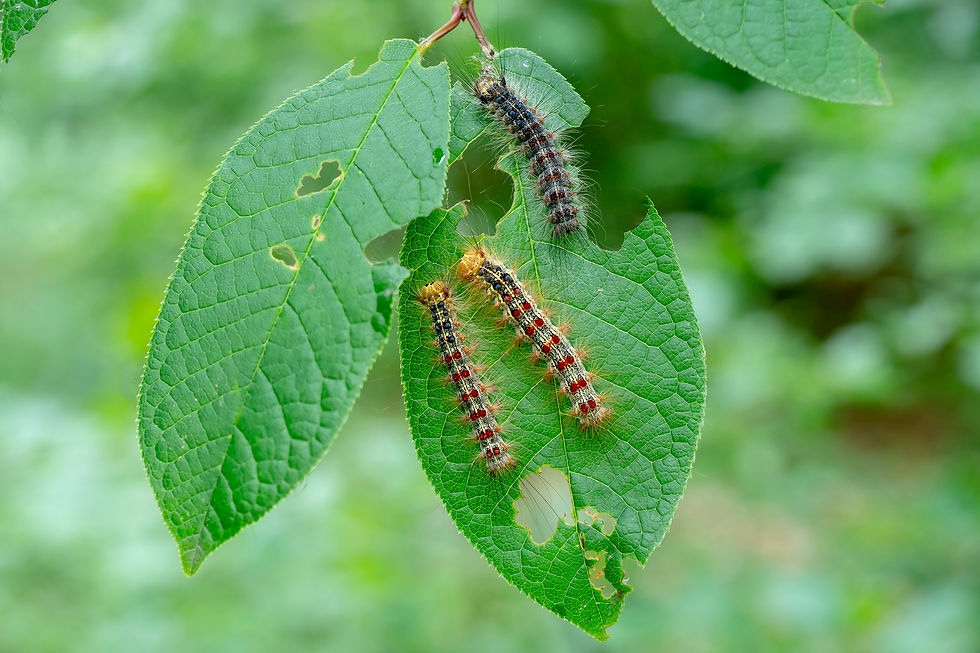
DCNR describes a hairy caterpillar with a yellow and black head and a distinctive pattern down its back: five pairs of blue spots followed by six pairs of red spots. That blue-then-red sequence is the feature to check first when you find a hairy caterpillar on an oak.
The egg mass
Females lay light tan egg masses in June and July, and each mass holds 100 to 1,500 eggs, according to DCNR. The eggs hatch from mid-April to early May the following spring. That gives you from late summer through early spring to find and remove masses before the next generation hatches.
Which Trees in Western PA Are Most at Risk?
Oaks top the list. DCNR notes that the caterpillars also feed on apple, birches, hemlock, pines and spruces, among hundreds of other species.
Conifers deserve extra attention. DCNR warns that defoliated conifers may die after a single season, while most hardwoods take more than one year of defoliation to die. A hemlock, pine or spruce that lost most of its needles this year is a higher priority to have checked than an oak that was stripped once.
For hardwoods, history matters. An oak that was defoliated in more than one year of the 2021 to 2024 outbreak is exactly the kind of tree DCNR's guidance points to. If oaks like that stand near your house, driveway or power lines, watch the upper crown for dead branches each summer.
How Many Years of Defoliation Does It Take to Kill a Tree?
There is no fixed count, and DCNR's guidance is the most useful rule of thumb available: more than one year for most trees, and a single season can be enough for conifers. Cornell University's Integrated Pest Management program adds that trees often bounce back and put out new growth once the caterpillars stop feeding for the season.
Cornell recommends watering stressed trees during dry spells to help them recover. If a tree does not put out new leaves after feeding stops, or if dead branches keep appearing in the crown the following spring, have it inspected. Our post on signs your tree is dying and what to do about it walks through what to look for.
Is Another Outbreak Coming?
The state tracks that question through egg mass counts. According to the Forest Service's 2025 Pennsylvania report, egg mass surveys in the 2024 to 2025 season found the sites with 800 or more egg masses per acre mainly in east-central and northeastern Pennsylvania, which forecast moderate to heavy defoliation in those areas. Western Pennsylvania was not named among them.
Suppression followed the survey. From April 30 through May 24, 2025, the state treated 52 spray blocks totaling 64,699 acres on state forests and parks, plus 10,080 acres of double applications, using Btk or tebufenozide, and the Pennsylvania Game Commission treated another 37,416 acres on its lands. Spongy moth populations rise and fall in cycles, so the egg masses on your own trees each fall are the best local forecast you have.
What Can Homeowners Do During an Infestation?
DCNR lists three steps a homeowner can take on a small scale:
Scrape egg masses into a container you can seal, then dispose of it.
Wrap burlap around tree trunks, where caterpillars hide, and remove the caterpillars you find under it.
Scrape caterpillars into a can of soapy water.
Wear gloves for all of it. Cornell notes that the tiny hairs on spongy moth caterpillars carry histamines that can cause an itchy, red rash in some people.
The state's spray program covers public land, not private yards. For spraying on your own property, talk with a pesticide applicator and ask about their certification and the products they plan to use. Our overview of pests that damage trees near Pittsburgh homes covers other insects that cause leaf loss.
When Should a Damaged Tree Be Removed?
Removal makes sense when a tree is dead or dying and something of value sits within reach of it. A dead oak over a roof, a driveway, a fence, or a play area is a hazard no matter what killed it. Our post on whether it is safe to leave a dead tree standing explains how to weigh that risk.
A dead tree deep in a wooded lot, with nothing it could hit, is usually a lower priority. Three questions shape the decision: is the tree still alive, how large is it, and what would it land on if it fell? When an oak does need to come down, why oak tree removal costs more in Western Pennsylvania breaks down the price factors.
Partial damage may call for pruning instead. If a living tree has a few dead limbs after defoliation, removing those branches lowers the chance of one dropping while you wait to see whether the tree recovers.
FAQ
Is spongy moth the same as gypsy moth?
Yes. DCNR notes that spongy moth was formerly known as gypsy moth.
Why are dead caterpillars hanging from my trees?
Disease is working in your favor. Cornell's IPM program explains that caterpillars killed by a virus hang in an upside-down V shape, while those killed by a fungus hang head down. Leave them where they are so the disease can spread to other caterpillars.
When do spongy moth eggs hatch in Pennsylvania?
DCNR says the eggs hatch from mid-April to early May.
Are the caterpillars harmful to people?
They can be irritating. Cornell notes the hairs carry histamines that cause an itchy, red rash in some people, so handle them with gloves.
Will my oak grow its leaves back this year?
Often it will. Cornell reports that trees often put out new growth after the caterpillars stop feeding for the season, and it recommends watering stressed trees during dry spells. If the leaves do not return, or dead branches show up the next spring, have the tree looked at.
Does the state spray private yards?
The 2025 program treated state forests and parks, and the Game Commission treated its own lands. For your property, you would hire a pesticide applicator directly.
Help With Damaged and Dead Trees From Brinko Tree Service
Brinko Tree Service, based at 1010 Sunset Blvd in Harrison City, serves homeowners and businesses across Westmoreland and Allegheny Counties with nearly 20 years of experience. When defoliation leaves an oak or conifer dead or dropping limbs, the team handles tree removal and pruning and trimming to take out dead or hazardous branches, along with stump grinding and complete cleanup. Brinko is fully licensed and insured, follows OSHA and ANSI safety regulations with an OSHA safety site supervisor on every job site, and offers free estimates.
Visit Brinko Tree Service or call 412-373-7450 today. Contact us for more information.


Comments